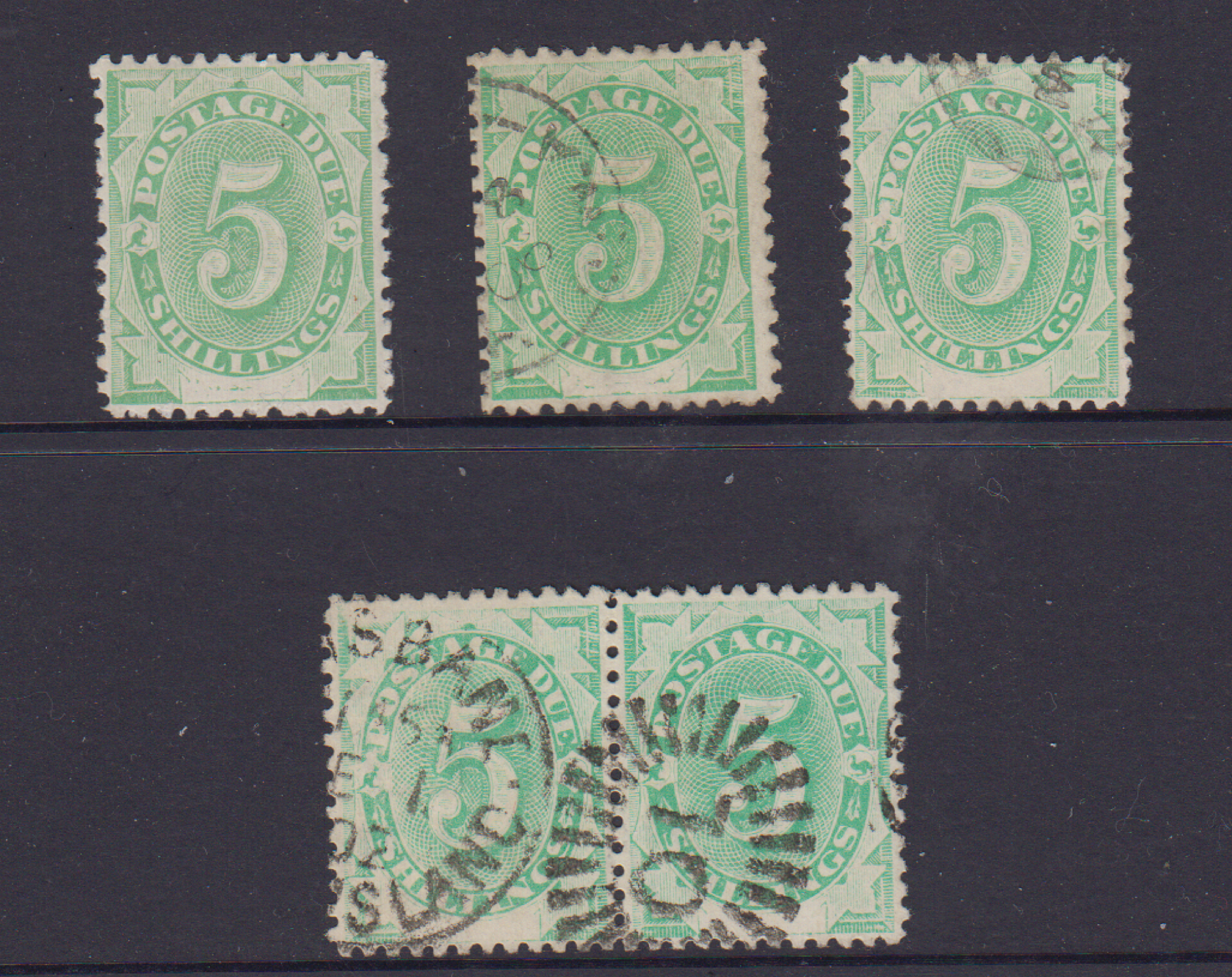
The following scan contains my 4 examples of this unlisted flaw. The flaw consists of between 6 and 10 (depending on how you count them) upward sloping scratches overlaying the usual horizontal lines of a normal right frame.
Fortunately, the 4th example of the flaw is on the left hand side of a pair of stamps and a comparison of their respective top right frames clearly shows the difference between a ‘normal’ stamp and one containing the flaw.
In a surprising twist of philatelic fate, the right hand side stamp of the pair also offers a rather fine example of Flaw 2 above, Scratch through “AGE” of postage.
Things become complicated on the question of whether the stamps came from the same sheet position or not. A comparison of the residual N.S.W. marks indicates that the stamps come from 4 different positions.
Stamps 3 and 4 share another flaw – a large white left vertical frame ‘blob’ on top of the ROO shield. However, these 2 stamps do not share 2 other features – stamp 3 has a pair of small vertical scratches in the left vertical frame above the left star point (and stamp 4 doesn’t) while Stamp 4 has a considerable white void on the top left vertical frame (and stamp 3 doesn’t). So, take your choice – same or different sheet position. I’ll go for different.
On the evidence of the blank frame arc, I would say that stamps 1 and 2 also come from different sheet positions. Stamp 1 has a large gap in the arc under the letters “ILL” whereas stamp 2 does not. Stamp2 has an arc break below “IN” and stamp 1 doesn’t. My experience is that these differences, resulting from the “N.S.W.” chiseling process, are quite consistent between stamps from the same position on different sheets.
Incidentally, the watermark on stamp 1 shows it comes from a position in Row 10. This does not occur with the other 3 stamps.
 Postage Due Stamps